Visualizzazione post con etichetta Ilan Pappe. Mostra tutti i post
Visualizzazione post con etichetta Ilan Pappe. Mostra tutti i post
domenica 8 gennaio 2017

martedì 15 novembre 2016
Novembre nero, di Ilan Pappe

Novantanove anni fa la Dichiarazione Balfour segnò l’inizio di un progetto di insediamento coloniale di proporzioni tragiche.

di Ilan Pappe – Ilan Pappe è il direttore dello European Center of Palestine Studies dell’Università di Exeter.
Novembre è un mese doloroso nel calendario palestinese. È punteggiato di giornate commemorative che hanno un tema in comune: la partizione della Palestina.
Oggi è il novantanovesimo anniversario della Dichiarazione Balfour. Per quanto non abbia proposto la partizione, ne ha piantato i semi, che alla fine hanno concesso al movimento sionista di prendersi la Palestina.
Il 15 novembre commemoriamo la Dichiarazione d’Indipendenza palestinese (promulgata dal Palestinian National Council [Pnc]), che ha costituito un consenso nazionale palestinese riluttante alla partizione, a dispetto di quanto fosse ingiusto e criminale tale atto.
Alla fine del mese, il 29, commemoriamo la Risoluzione generale dell’Onu n. 181, che suggeriva la partizione della Palestina in due Stati.
Se li mettiamo in ordine cronologico, possiamo vedere una linea che unisce la Dichiarazione Balfour del 1917, la Risoluzione dell’Onu del 1947 e il documento del Pnc del 1988. Vale la pena che rileggiamo il saggio commento di Edward Said alla Dichiarazione Balfour.
«L’aspetto importante nella Dichiarazione Balfour è,1) che è stata a lungo la base giuridica delle rivendicazioni sioniste sulla Palestina e2) (ancor più importante per i nostri fini) che è stata una dichiarazione la cui forza può esser apprezzata solo quando sono state chiaramente comprese le realtà demografica e umana della Palestina. Perché la Dichiarazione è stata fatta: a) da un potere europeo b) a riguardo di un territorio non europeo c) nel pieno disprezzo sia della presenza sia dei desideri della maggioranza nativa residente in quel territorio, e d) ha preso la forma di una promessa riguardo quello stesso territorio a un altro gruppo straniero, cioè che quel gruppo straniero avrebbe potuto, letteralmente, far di quel territorio la madrepatria del popolo ebraico».
In realtà è stata ancor più di questo: ha permesso che un movimento di stanziamento di coloni, apparso storicamente molto tardi, immaginasse un progetto trionfale ben prima di aver davvero messo piede su quella terra o di avervi una presenza geografica e demografica significativa.
«La logica dell’eliminazione del nativo»
La popolazione nativa della Palestina era molto meglio equipaggiata degli indiani americani o degli aborigeni nell’affrontare il pericolo del sionismo, appena arrivato nel suo territorio.
Ai tempi aveva anche molto più chiaro il concetto di autodeterminazione e nazionalità rispetto agli altri popoli indigeni.

Nel 1936 l’esercito britannico utilizzò forze enormi, tra cui la Royal Air Force, per soffocare la ribellione palestinese. Durò tre anni e terminò con l’eliminazione da parte dei britannici della leadership palestinese nazionale, che venne uccisa o mandata in esilio.
Questo fu il maggiore retaggio del progetto di Balfour: non il testo consacrato, ma le politiche che ne derivarono e che alla fine condussero alla catastrofe del 1948.
Ci furono ufficiali britannici, sia tra quelli rientrati in patria sia tra quelli rimasti in loco, che ebbero ripensamenti e rimorsi riguardo l’alleanza con il sionismo. Poterono esprimere la propria opinione quando il governo britannico incaricò una Commissione d’inchiesta di esaminare le motivazioni all’origine della rivolta del 1936.
La Commissione sperava di porre riparo ad alcune delle ingiustizie commesse suggerendo una divisione della terra fra i coloni e la popolazione nativa.
La leadership sionista fece pressioni sui britannici perché trasferissero i Palestinesi da tutti i territori che sarebbero stati concessi ai coloni sionisti, ma Londra rifiutò di farlo.
Tuttavia, legittimando la partizione della Palestina come una «soluzione» con credibilità internazionale, la Gran Bretagna associò chiaramente questo accordo geografico con l’impulso di base di ogni movimento di insediamento di coloni, che in seguito venne brillantemente definito da Patrick Wolfe come «la logica dell’eliminazione del nativo».
Il mondo arabo sostenne il rifiuto palestinese della Dichiarazione e all’inizio sperò di cambiarla tramite accordi diplomatici. Nei primi mesi del 1948, quando divenne chiaro che era iniziata una vera pulizia etnica in Palestina, l’opinione pubblica nei Paesi arabi chiese di più ai propri governi.
Con un tale avallo, non c’è da stupirsi se, da quel momento in poi, partizione e pulizia etnica nel pensiero e nella pratica sionisti procedettero di pari passo.
All’inizio di febbraio del 1947, quando il gabinetto britannico annunciò di voler lasciare la Palestina e affidò il futuro del Paese alle Nazioni Unite, ancora una volta vi fu l’opportunità di rendere una cosa sola la partizione e il trasferimento della popolazione.
Questa volta la leadership sionista non cercò la legittimazione internazionale per il trasferimento, ma solo per la partizione. Dette per scontato, a ragione, che la partizione, soprattutto ad appena due anni dall’Olocausto, sarebbe stata accettata dall’opinione pubblica internazionale come una soluzione morale e ragionevole.
Un crimine europeo
Il naturale rifiuto dei Palestinesi dell’idea di dividere la loro patria con i coloni, la maggioranza dei quali erano arrivati solo pochi anni prima, cadde inascoltato alle orecchie degli Occidentali.
Collocare gli Ebrei in Palestina, senza la necessità di assumersi la responsabilità di quel che l’Europa aveva fatto loro durante la Seconda guerra mondiale, divenne la miglior via d’uscita dal più terribile momento storico vissuto dall’Europa.
Come appare oggi evidente dai documenti, la leadership sionista considerava la risoluzione sulla partizione come una legittimazione internazionale di uno Stato ebraico in Palestina, e il suo rifiuto da parte palestinese come un valido pretesto per la pulizia etnica nei confronti della popolazione nativa.
Il mondo arabo sostenne il rifiuto palestinese della Dichiarazione e all’inizio sperò di cambiarla tramite accordi diplomatici. Nei primi mesi del 1948, quando divenne chiaro che era iniziata una vera pulizia etnica in Palestina (entro l’inizio di maggio la popolazione della maggior parte delle città palestinesi venne trasferita o uccisa, e alcuni insediamenti abitativi furono interamente cancellati dalle forze sioniste), l’opinione pubblica nei Paesi arabi chiese di più ai propri governi.
L’ultima goccia fu il massacro di Dar Yassin dell’aprile 1948. In seguito a ciò, la Lega araba cominciò a coordinare un’operazione militare su vasta scala per fermare la distruzione della Palestina.
Non tutti i leader arabi erano sinceramente interessati a questo scopo, e nessuno di loro era intenzionato a impiegare nella campagna una forza militare significativa.
Il risultato fu la totale disfatta a opera delle forze israeliane, che continuarono senza alcun rimprovero o intervento internazionale, la pulizia etnica nei confronti dei Palestinesi.
Occupazione
Due aree rimasero fuori dalla portata degli Israeliani: la Striscia di Gaza e la Cisgiordania. Non perché a quell’epoca a Israele mancasse la forza per occuparle, ma perché i suoi leader decisero che la Cisgiordania era un peso dal punto di vista demografico e che la Striscia di Gaza poteva essere utile come enorme recettore delle centinaia di migliaia di rifugiati buttati fuori dalle loro case dagli Israeliani a sud di Giaffa e Gerusalemme.
Tuttavia, già a partire dal 1948, una lobby si era mossa in Israele per ottenere l’occupazione di questi ultimi scampoli di Palestina. L’opportunità si presentò nel 1967.
Tuttavia, già a partire dal 1948, una lobby si era mossa in Israele per ottenere l’occupazione di questi ultimi scampoli di Palestina. L’opportunità si presentò nel 1967.
Poco dopo apparve chiaro che, almeno per alcuni degli Israeliani, questa non era una novità gradita: occupare le terre di milioni di Palestinesi causò un inaspettato mal di capo politico e per un certo periodo un onere economico.
La fazione pacifica israeliana da un lato desiderava controllare queste due aree dall’esterno e garantire loro l’autonomia e, più tardi, alcuni membri del movimento furano addirittura favorevoli a che le due aree costituissero uno Stato.
Contemporaneamente i coloni, con o senza l’avallo governativo, cominciarono a colonizzare la Cisgiordania e la Striscia di Gaza.
Come nel 1936, anche nel 1987 un popolo oppresso cercò di scrollarsi di dosso il progetto coloniale. Questa volta ci furono alcune positive reazioni internazionali che l’Olp (Organizzazione per la liberazione della Palestina) sperò spronassero ad agire in favore della causa. Sembrò che addirittura gli Usa, nel periodo successivo alla guerra fredda, potessero cambiare il proprio atteggiamento.
Sostituire presenza con assenza
L’avallo americano richiese un prezzo: che l’Olp riconoscesse la partizione della Palestina e accettasse la perdita di quasi l’80% del suo territorio.
La Dichiarazione di Indipendenza si barcamenò tra il pragmatismo richiesto e la lealtà ai principî morali fondamentali del movimento di liberazione. La partizione fu riconosciuta sia come crimine sia come fait accompli.
A dispetto dell’ingiustizia sociale perpetrata ai danni della popolazione araba palestinese sia con il suo trasferimento sia con il privarla del diritto all’autodeterminazione, in seguito all’adozione della Risoluzione dell’Assemblea generale n. 181 (II) del 1947, che divise la Palestina fra uno Stato arabo e uno ebraico, questa Risoluzione – nonostante tutto – continua a dettare le precondizioni alla legittimità internazionale che garantisce alla popolazione araba palestinese il diritto di sovranità e di indipendenza nazionale.
Avrebbe potuto funzionare se la partizione fosse stata una vera e propria strategia o una visione dello Stato colonizzatore d’Israele. Concedere l’esclusività demografica e il possesso geografico totale, però, è uno scenario inimmaginabile per qualsiasi progetto di insediamento coloniale. L’intento è allontanare i nativi e rimpiazzarli con i coloni; o, come ha detto benissimo Edward Said, sostituire la presenza con l’assenza.
Dalla prospettiva israeliana/sionista la partizione può essere solo un mezzo per completare il progetto di insediamento dei coloni; non può essere usata per limitare o rinunciare al progetto.
Dalla prospettiva israeliana/sionista la partizione può essere solo un mezzo per completare il progetto di insediamento dei coloni; non può essere usata per limitare o rinunciare al progetto.
Quindi la Dichiarazione di Indipendenza non influisce sulla realtà fisica, né lo fanno tutti i successivi tentativi internazionali, regionali o locali di rivendere l’idea della partizione come una «soluzione con due Stati».
La discussione sulla partizione continua, mentre la realtà dell’insediamento coloniale copre ormai quasi ogni centimetro della Palestina storica.
Novembre è un buon mese per chiedersi per quale motivo la partizione, descritta dagli Americani come il modo migliore per mantenere felici i vicini, si identifica con l’occupazione, la colonizzazione e la pulizia etnica.
I semi sono stati seminati nel 1917, il raccolto è stato mietuto nel 1947 e da allora ha avvelenato il Paese. È tempo di adottare un nuovo punto di vista morale e politico su questa questione per costruire un futuro migliore.
Ilan Pappe è il direttore dello European Center of Palestine Studies dell’Università di Exeter. Ha pubblicato quindici libri sul Medio Oriente e sulla questione palestinese.
Le opinioni espresse nell’articolo sono dell’autore e non necessariamente riflettono la politica editoriale di Al Jazeera’s.
Trad. Chiuz-Invictapalestina
Fonte: Al Jazeera
https://invictapalestina.wordpress.com/2016/11/11/novembre-nero/
giovedì 6 ottobre 2016
Shimon Peres from the perspective of his victims, by Ilan Pappe
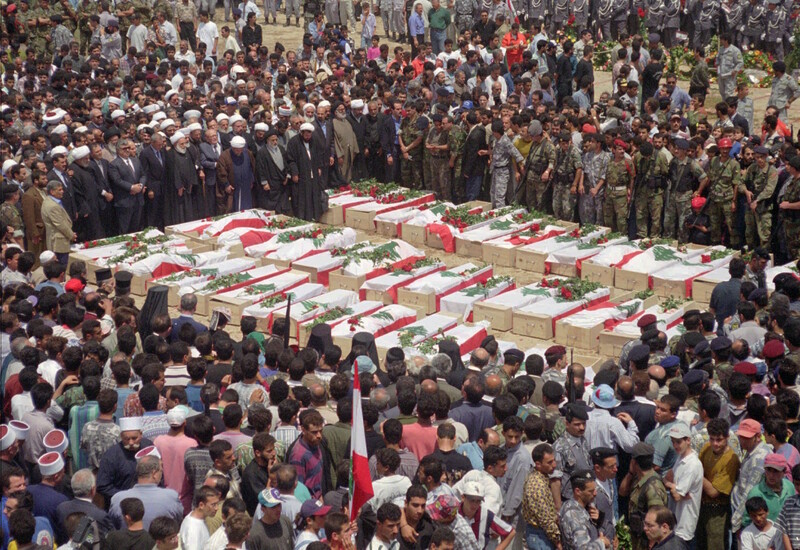
Officials and mourners surround coffins covered with Lebanese flags during a mass funeral in the southern Lebanese town of Tyre, 30 April 1996. The victims were killed in an Israeli artillery attack on a UN base in Qana, in southern Lebanon, on 18 April as part of an operation ordered by then Israeli Prime Minister Shimon Peres.
AP Photo
The obituaries for Shimon Peres have already appeared, no doubt prepared in advance as the news of his hospitalization reached the media.
The verdict on his life is very clear and was already pronounced by US President Barack Obama: Peres was a man who changed the course of human history in his relentless search for peace in the Middle East.
My guess is that very few of the obituaries will examine Peres’ life and activities from the perspective of the victims of Zionism and Israel.
He occupied many positions in politics that had immense impact on the Palestinians wherever they are. He was director general of the Israeli defense ministry, minister of defense, minister for development of the Galilee and the Negev (Naqab), prime minister and president.
In all these roles, the decisions he took and the policies he pursued contributed to the destruction of the Palestinian people and did nothing to advance the cause of peace and reconciliation between Palestinians and Israelis.
Born Szymon Perski in 1923, in a town that was then part of Poland, Peres immigrated to Palestine in 1934. As a teenager in an agricultural school, he became active in politics within the Labor Zionist movement that led Zionism and later the young State of Israel.
As a leading figure in the movement’s youth cadres, Peres attracted the attention of the high command of the Jewish paramilitary force in British-ruled Palestine, the Haganah.
Nuclear bomb
In 1947, Peres was fully recruited to the organization and sent abroad by its leader David Ben-Gurion to purchase arms which were later used in the 1948 Nakba, the ethnic cleansing of Palestinians, and against the Arab contingents that entered Palestine that year.
After a few years abroad, mainly in the United States, where he was busy purchasing arms and building the infrastructure for the Israeli military industry, he returned to become director general of the defense ministry.
Peres was active in forging Israel’s collusion with the UK and France to invade Egypt in 1956, for which Israel was rewarded by France with the needed capacity to build nuclear weapons.
Indeed it was Peres himself who largely oversaw Israel’s clandestine nuclear weapons program.
No less important was the zeal Peres showed under Ben-Gurion’s guidance and inspiration to Judaize the Galilee. Despite the 1948 ethnic cleansing, that part of Israel was still very much Palestinian countryside and landscape.
Peres was behind the idea of confiscating Palestinian land for the purpose of building exclusive Jewish towns such as Karmiel and Upper Nazareth and basing the military in the region so as to disrupt territorial contiguity between Palestinian villages and towns.
This ruination of the Palestinian countryside led to the disappearance of the traditional Palestinian villages and the transformation of the farmers into an underemployed and deprived urban working class. This dismal reality is still with us today.
Settlers’ champion
Peres disappeared for a while from the political scene when his master Ben-Gurion, Israel’s founding prime minister, was pushed aside in 1963 by a new generation of leaders.
He came back after the 1967 War and the first portfolio he held was as minister responsible for the occupied territories. In this role, he legitimized, quite often retroactively, the settlement drive in the West Bank and Gaza Strip.
As so many of us realize today, by the time the pro-settlement Likud party came to power in 1977, the Jewish settlement infrastructure, in particular in the West Bank, had already rendered a two-state solution an impossible vision.
In 1974, Peres’ political career became intimately connected to that of his nemesis, Yitzhak Rabin. The two politicians who could not stand each other, had to work in tandem for the sake of political survival.
However, on Israel’s strategy toward the Palestinians, they shared the Zionist settler-colonial perspective, coveting as much of Palestine’s land as possible with as few Palestinians on it as possible.
They worked well together in quelling brutally the Palestinian uprising that began in 1987.
Peres’ first role in this difficult partnership was as defense minister in the 1974 Rabin government. The first real crisis Peres faced was a major expansion of the messianic settler movement Gush Emunim’s colonization effort in and around the West Bank city of Nablus.
Rabin opposed the new settlements, but Peres stood with the settlers and those colonies that now strangulate Nablus are there thanks to his efforts.
In 1976, Peres led government policy on the occupied territories, convinced that a deal could be struck with Jordan, by which the West Bank would be within Jordanian jurisdiction but under effective Israeli rule.
He initiated municipal elections in the West Bank but to his great surprise and disappointment, the candidates identified with the Palestine Liberation Organization were elected and not the ones loyal to Jordan’s Hashemite monarchy.
But Peres remained faithful to what he named the “Jordanian option” as an opposition leader after 1977 and when he returned to power in coalition with the Likud in 1984-1988. He pushed forward the negotiations on the basis of this concept until King Hussein’s decision to cede any political connection between Jordan and the West Bank in 1988.
Israel’s international face
The 1990s exposed to the world to a more mature and coherent Peres. He was Israel’s international face, whether in government or outside it. He played this role even after the Likud ascended as the main political force in the land.
In power, in Rabin’s government in the early 1990s, as prime minister after Rabin’s 1995 assassination, and then as a minister in the cabinet of Ehud Barak from 1999 to 2001, Peres pushed a new concept for what he called “peace.”
Instead of sharing rule in the West Bank and Gaza Strip with Jordan or Egypt, he now wished to do it with the Palestine Liberation Organization. The idea was accepted by PLO leader Yasser Arafat, who may have hoped to build on this a new project for the liberation of Palestine.
As enshrined in the 1993 Oslo accords, this concept was enthusiastically endorsed by Israel’s international allies.
Peres was the leading ambassador of this peace process charade that provided an international umbrella for Israel to establish facts on the ground that would create a greater apartheid Israel with small Palestinianbantustans scattered within it.
The fact that he won a Nobel Peace Prize for a process that advanced the ruination of Palestine and its people is yet another testimony to world governments’ misunderstanding, cynicism and apathy toward their suffering.
We are fortunate to live in an era in which international civil society has exposed this charade and offers, through the boycott, divestment and sanctions movement and the growing support for the one-state solution, a more hopeful and genuine path forward.
Qana
As prime minister, Peres had one additional “contribution” to make to the history of Palestinian and Lebanese suffering.
In response to the endless skirmishes between Hizballah and the Israeli army in southern Lebanon, where Hizballah and other groups resisted the Israeli occupation that began in 1982 until they drove it out in 2000, Peres ordered the bombing of the whole area in April 1996.
During what Israel dubbed Operation Grapes of Wrath, Israeli shelling killed more than 100 people – civilians fleeing bombardment and UN peacekeepers from Fiji – near the village of Qana
Despite a United Nations investigation that found Israel’s explanation that the shelling had been an accident to be “unlikely,” the massacre did nothing to dent Peres’ international reputation as a “peacemaker.”
In this century, Peres was more a symbolic figurehead than an active politician. He founded the Peres Center for Peace, built on confiscated Palestinian refugee property in Jaffa, which continues to sell the idea of a Palestinian “state” with little land, real independence or sovereignty as the best possible solution.
That will never work, but if the world continues to be committed to this Peres legacy, there will be no end to the suffering of the Palestinians.
Shimon Peres symbolized the beautification of Zionism, but the facts on the ground lay bare his role in perpetrating so much suffering and conflict. Knowing the truth, at least, helps us understand how to move forward and undo so much of the injustice Peres helped create.
The author of numerous books, Ilan Pappe is professor of history and director of the European Centre for Palestine Studies at the University of Exeter.
https://electronicintifada.net/content/shimon-peres-perspective-his-victims/18096
giovedì 22 ottobre 2015
Israeli colonisation is at the root of the violence, by Ilan Pappe
In the midst of what has become known in Israel as the "knifers' Intifada", an unusual scene unfolded in Ramat Gan, where many of the residents are Iraqi Jews. A small slender woman was protecting a man lying on the ground who was being pursued by a mob of 40 people, including a few soldiers, who wanted to lynch him.
While lying on the ground, pepper gas was sprayed into his eyes at close range. He managed to whisper to his guardian angel: "I am a Jew." When the mob finally got the message, he was left alone.
He was chased because almost all the Iraqi Jews look like Palestinians; in fact, most of us Jews in Israel look like Palestinians. The only Jews who are "protected" are the Mizrahi Orthodox Jews who don the same clothes their Ashkenazi predecessors wore in 17th-century Europe, dismissing their traditional "Arab" dress.
Invisible people
| Inside story - Is a third Palestinian Intifada imminent? |
This attack was not the only one. Other Arab Jews have been mistaken for Palestinians. Being considered an Arab in Israel, even based on looks, means you are part of the invisible, disempowered and dispensable natives.
Such an attitude is not unique in history. Most settler colonial societies adopted this attitude towards the natives: Natives, for settler-colonial societies, are an obstacle to be removed along with the stones in the fields, the mosquitoes in the swamps, and in the case of early Zionism, with the less fit - physically and culturally - Jews.
After the Holocaust, Zionism could not afford to be that choosy any more.
When one analyses the origins of the present Intifada, one can rightly point to the occupation and the expanded Jewish colonisation.
But the desperation that has produced the current unrest isn't a direct outcome of the 1967 colonisation, but rather, of nearly 100 years of invisibility, dehumanisation and potential destruction of the Palestinian people, wherever they are.
How deeply this denial of the humanity of the natives of Palestine is rooted in today's Israeli political discourse could be seen in the two main speeches by Prime Minister Benjamin Netanyahu and the leader of the opposition, Yitzhak Herzog, given on Tuesday at the Knesset.
It was the Israeli policy and actions against Al-Aqsa that ignited the present wave of protests and individual attacks. But it was triggered by a century-long atrocity: the incremental culturecide of Palestine.
|
Netanyahu explained very well why the Palestinian desperation will produce more and more Intifadas in the future and why Israel's international delegitimisation will increase exponentially.
He described 100 years of colonisation as a proud project that for no good reason, other than Islamic incitement, was resisted by the native people of Palestine.
The message to the Palestinians was clear: Accept your fate as invisible, citizen-less inmates of the biggest prison on earth in the West Bank and the Gaza Strip, and as a community under a severe apartheid regime, and we can all live in peace. Any attempt to reject this reality is terrorism of the worst kind and will be dealt with accordingly.
Within this narrative, if his speechwriter was attempting to calm down worries in the Muslim world about the fate of al-Haram al-Sharif (the Noble Sanctuary), the opposite message came through. Much of his speech about al-Haram al-Sharif was a history lesson on why the place belongs to the Jewish people.
And although he ended this section with a promise not to change the status quo, the presence of the leaders of a party strongly believing in the need to build a third temple there was hardly reassuring.
'Never together'
In his speech, Herzog, the leader of the liberal Zionist opposition, manifested the dehumanisation of the Palestinians in a different way. His nightmare, he stressed repeatedly, was a country where Jews and Palestinians would live together.
Therefore, separation, ghettoisation, and enclaves are the best solution, even if it means shrinking a bit of greater Israel. "We are here, and they are there," he repeated Ehud Barak and Shimon Peres' famous slogan from the late 1990s.
Haaretz's liberal Zionist journalist, Barak Ravid, repeated the horror of liberal Zionists: If you have a binational state, stabbings will be a daily occurrence, he warned. The idea that a liberated Israel/Palestine will be a democracy for all has never been on the liberal Zionist agenda.
This wish not to share life with anything Arab is an attitude felt by every Palestinian on a daily basis. More than a century of colonisation and nothing has changed in the complete denial of the native Palestinians' humanity or their right to the place.
It was Israeli policy and actions against Al-Aqsa Mosque that ignited the present wave of protests and individual attacks. But it was triggered by a century-long atrocity: the incremental culturecide of Palestine.
 |
The Western world was horrified by the destruction of ancient cultural gems by the Islamic State of Iraq and the Levant (ISIL). The Israeli destruction and wiping out of the Islamic heritage of Palestine was far more extensive and significant. Hardly one mosque remained intact after the Nakba, and many of those remaining were turned into restaurants, discotheques, and farms.
The Palestinians' attempt to revive their theatrical and literary heritage is considered by Israel as a commemoration of the Nakba, and is outlawed if undertaken by anybody who relies on governmental funding.
What we see - and will continue to see - in Palestine is the existential struggle of the native people of a country still under threat of destruction.
Ilan Pappe is the director of the European Center of Palestine Studies at the University of Exeter. He has published 15 books on the Middle East and on the Palestine Question.
The views expressed in this article are the author's own and do not necessarily reflect Al Jazeera's editorial policy.
Source: Al Jazeera
http://www.aljazeera.com/indepth/opinion/2015/10/israeli-colonisation-root-violence-palestine-151019142927288.html
Iscriviti a:
Post (Atom)